AcreWatch Auto
A pass for every stage the crop goes through.
A dock on the farm flies the crop's own schedule rather than a calendar: a pass at each growth stage that carries a decision, and flights in between to catch what changes. Findings land the day of the flight, and the prescription goes to the machine that runs it.
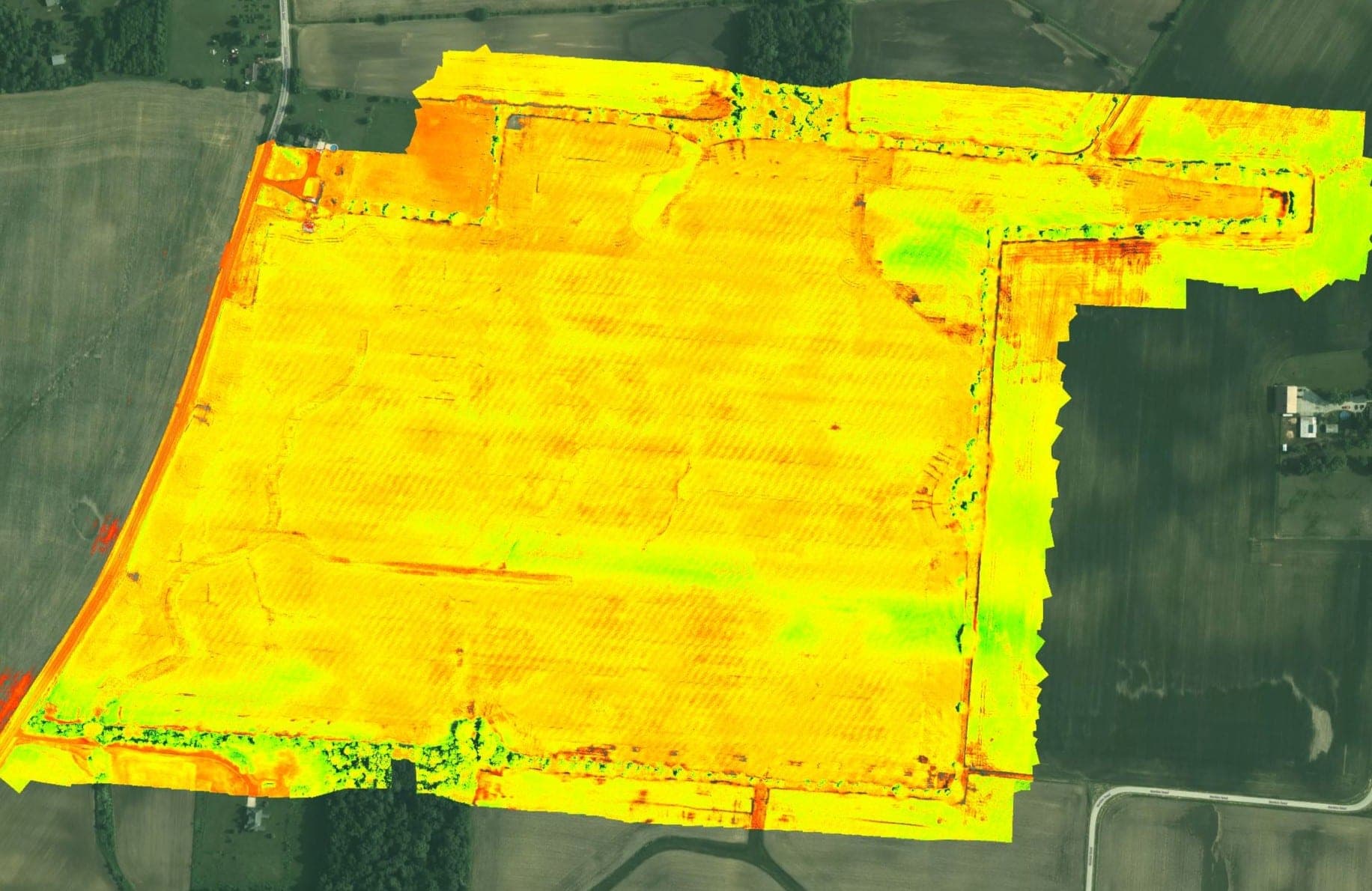
What lands
- A scheduled pass at each growth stage, pre-plant to pre-harvest: stand, weeds, nitrogen, disease, efficacy, lodging, drydown
- Flights between passes for change detection
- Prescription load files for your planter, pivot, and robots, and for the spray drones that take them: DJI Agras, XAG, EAVision, Hylio, Ceres Air
- One-page report per pass with the finding and the action
Plans
A credit is one flight.
Crop
Buy the dock
from $1,160/mo
on a dock you own
- Monthly service includes one flight
- A per-acre rate for each crop pass, eight passes a season for corn
- Additional flights that are not an analysis pass, $100 each
Lease the trailer
from $4,325/mo
8-month minimum, growing season
- Plus a per-acre rate for each crop pass
- We own the trailer dock. Nothing to buy and nothing to finance
- It moves: the pad and the power run are not your problem
Neighboring operations can fly off your trailer at a per-acre rate with no lease of their own. A share of what they pay is credited against your lease.
Purchase packages from $40,335, plus a three-year service plan. The survey sets the final figure, because the pad, the power and the connectivity are different on every site.
What it saves
A monthly figure is only half the sum. Here is the other half, in numbers somebody other than us published.
Crop
Put the input where it pays
Product and application put a fungicide pass somewhere near $18 to $20 an acre by the time it is on the ground, versus a scouting pass at a fraction of that cost. If the map says skip a quarter of a 500-acre field, that one pass kept about $2,300 of product and application in your pocket, and you still have the record of why you skipped it.
Labor
The drive is the expensive part
USDA put the average gross wage across all hired farm workers at $19.52 an hour in April 2025, and $18.15 for livestock workers. Two hours a day driving out to look at fields or pastures is roughly $1,100 a month of somebody's time before the truck, and it is time spent on the search rather than on the problem. Monthly service on a dock you own starts at $1,275, and the flight happens whether or not anybody has the morning free.
Source: USDA NASS, Farm Labor
Published figures from the sources named, not our estimates of your operation. Your acres, your inputs and your labor decide what this is actually worth, which is what the site survey is for.
And on our own prices
Arithmetic on the plans above, so it stays true when they change.
One pass can pay for the season
The crop plan is a monthly minimum from $1,160 plus a per-acre rate for each pass. A fungicide decision alone is $18 to $20 an acre, so the pass that says 'skip these 120 acres' covers more than a month of service by itself.
On crop, a lease is about thirteen months of the difference
The trailer lease starts at $4,325 a month against $1,160 on a dock you own, a difference of about $3,165. A purchase package from $40,335 is about thirteen months of that difference, before the service plan.
Neighbors bring the lease down
Neighboring operations can fly off your trailer at a per-acre rate with no lease of their own. A share of what they pay is credited against your lease, so a ring of enrolled neighbors cuts what the host pays every month of the season.
The crop sets the schedule
Every pass is tied to a growth stage that carries a decision, not to a date on a calendar. How many of them there are depends on what is planted.
- Corn8 passes
- Soybeans8 passes
- Winter wheat8 passes
- Grain sorghum (milo)8 passes
- Cotton (West)9 passes
- Sunflowers (West)6 passes
- Dry edible beans (MI, ND, NE)6 passes
- Sugar beets (MI, ND, NE)7 passes
- Peanuts (GA, TX, OK)6 passes
- Alfalfa / hay2 passes per cutting
- Processing tomatoes (NW Ohio)5 passes
- Pumpkins / vine crops4 passes
- Sweet corn6 passes
- Apples / hops5 passes
Windows assume west-central Ohio in a normal year unless the crop names its own region. Stages drive the timing; the dates are a planning aid.
What one looks like: corn
| Stage | Window | What the pass decides |
|---|---|---|
| Pre-plant | Apr 1-25 | Drainage map; plant order by field |
| VE-V2 | 7-14 d after planting | Population map; replant go/no-go by field |
| V5-V6 | 3-4 wk after emergence | Weed map; post-emerge Rx load file (spot or zone) |
| V8-V10 | mid-June | Sidedress Rx; VR N map to Operations Center |
| VT-R1 | early/mid July | Fungicide go/no-go map; Rx load file if go |
| R2-R3 | late July-early Aug | Efficacy check; insurance documentation |
| R4-R5 | late Aug-mid Sept | Harvest-priority ranking by field |
| Pre-harvest | late Sept-Oct | Harvest order; yield map reference layer |
Pre-plantApr 1-25
Drainage map; plant order by field
VE-V27-14 d after planting
Population map; replant go/no-go by field
V5-V63-4 wk after emergence
Weed map; post-emerge Rx load file (spot or zone)
V8-V10mid-June
Sidedress Rx; VR N map to Operations Center
VT-R1early/mid July
Fungicide go/no-go map; Rx load file if go
R2-R3late July-early Aug
Efficacy check; insurance documentation
R4-R5late Aug-mid Sept
Harvest-priority ranking by field
Pre-harvestlate Sept-Oct
Harvest order; yield map reference layer
Get a Site Survey.
Tell us where you are and what we are watching. We map the property, pick the dock location, and prepare the site package for your site.